- Edward Muriuki, Acting Director of the Kenya Meteorological Department, recently explained that the country is now transitioning into the March–April–May long rains season.
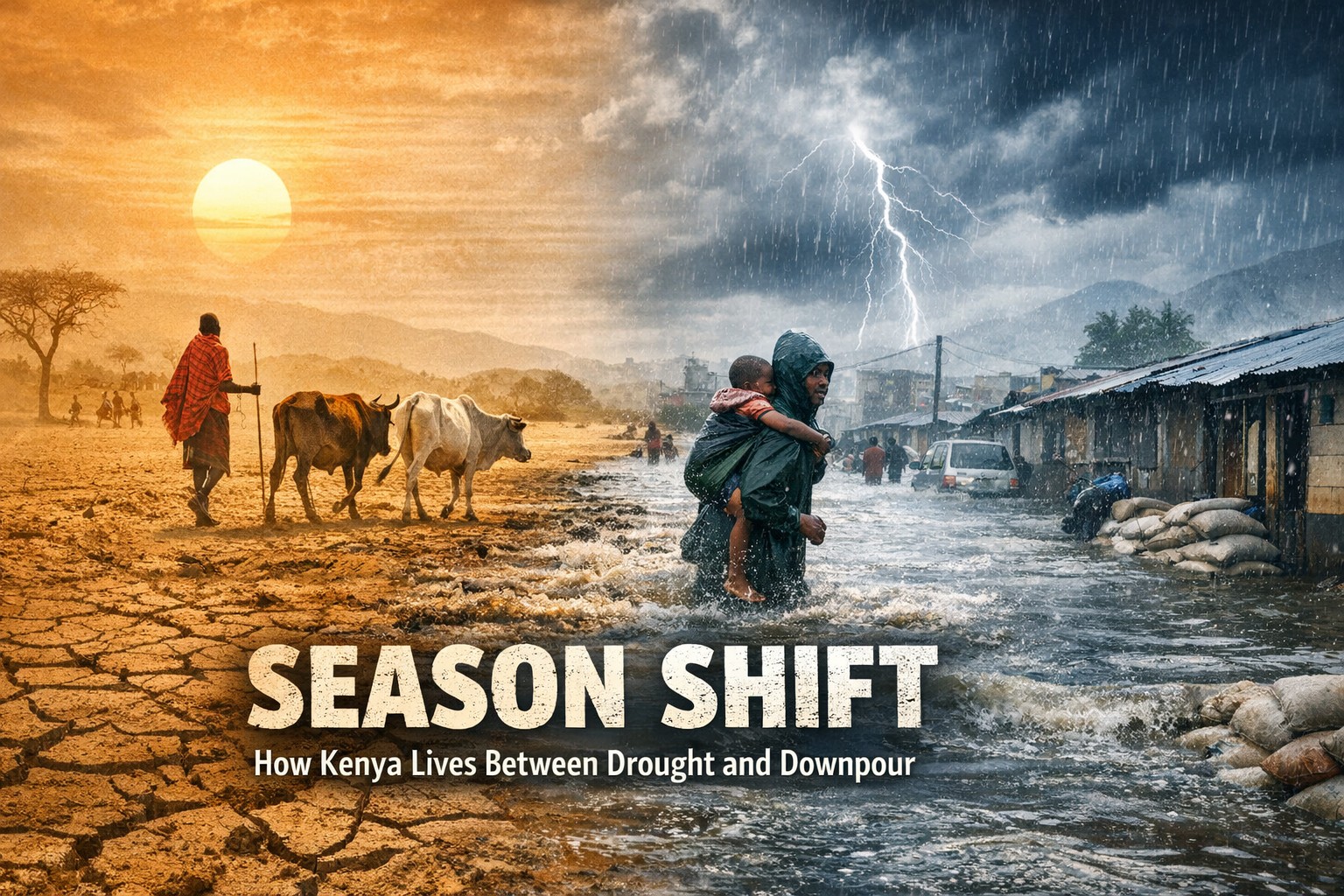
In some parts of Kenya today, people no longer ask whether it will rain. They ask how it will rain.
Will it vanish for weeks, leaving the land cracked and dusty, or arrive all at once to flood homes within hours? The question is no longer about seasons. It is about extremes.
Across the country, weather patterns swing between prolonged dry spells and sudden heavy storms. The Kenya Meteorological Department has reported delayed rains, short intense bursts, and uneven distribution across regions. For many communities, this means preparing for two opposite risks at the same time.
In arid and semi‑arid counties such as Turkana and Garissa, drought remains a constant threat. Pastoralists move livestock earlier than they once did, searching for pasture that may not last. Water pans dry quickly. Families rely more heavily on storage tanks and relief supplies during extended dry periods. A failed rainy season can mean lost animals, reduced income, and food insecurity.
Read More
In urban centres like Nairobi, the danger looks different. A single afternoon storm can overwhelm drainage systems and flood low‑lying estates. Roads turn into rivers. Public transport slows. Small businesses shut to avoid losses. For families in flood‑prone areas, heavy rainfall brings anxiety rather than relief.
Residents are adapting in practical ways. Farmers in peri‑urban areas experiment with drought‑resistant crops and staggered planting. Some households raise doorsteps and reinforce foundations with sandbags. Community groups organise drainage clean‑ups before the rains. Many now follow short‑term forecasts more closely than traditional seasonal expectations.
Climate experts note that while Kenya has always faced cycles of drought and heavy rain, the frequency and intensity of extremes are increasing. What used to be occasional shocks are becoming part of daily life.
Edward Muriuki, Acting Director of the Kenya Meteorological Department, recently explained that the country is now transitioning into the March–April–May long rains season.
“In the past two weeks, we have experienced some off‑season rains. The rains have begun earlier than expected,” he said during Citizen TV’s Monday Report on March 2, 2026.
He attributed the unusual February showers to the Madden‑Julian Oscillation (MJO), a global weather phenomenon that influences rainfall patterns.
Muriuki clarified that heavy rainfall does not automatically translate into flooding, but warned of significant downpours in 22 counties beginning this week.
These include Kisumu, Siaya, Busia, Migori, Homa Bay, Kisii, Nyamira, Kakamega, Bungoma, and Vihiga in western Kenya; Nakuru, Baringo, Kericho, and Bomet in the Rift Valley; and Nairobi, Kiambu, Nyeri, Murang’a, Kirinyaga, Embu, and Meru in the highlands east of the Rift Valley.
He noted that rainfall patterns are largely influenced by the movement of the Intertropical Convergence Zone, a belt of low pressure that shifts north and south with the overhead sun. This shifting belt is what drives Kenya’s two major rainy seasons—March to May and October to December.
Living between drought and downpour requires constant adjustment. It means saving water in the dry months and bracing for floods in the wet ones. It means planning without certainty. For many Kenyans, resilience is no longer a choice. It is a daily necessity shaped by skies that rarely behave the way they once did.
Follow us on WhatsApp for community voices, and stories that matter
-1785307406.jpeg)

-1784287755.jpg)