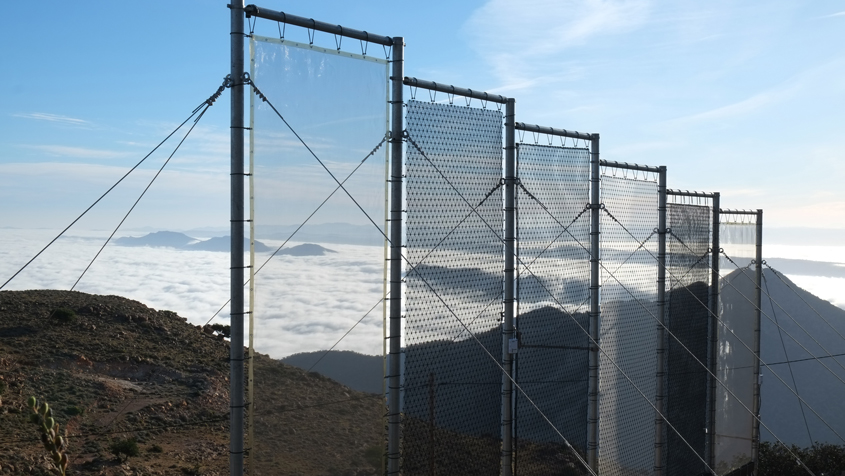
- As fog drifts through, tiny droplets condense, merge, and trickle into storage tanks. The result is clean water, gathered without depleting rivers or aquifers.
- Unlike energy intensive methods such as desalination, fog harvesting is carbon neutral, low cost, and community driven. It is practical, resilient, and tailored to the realities of climate change.
When climate change alters rainfall, temperature, and weather extremes, it directly changes what happens to water. Rivers shrink, aquifers dry, and floods contaminate supplies. What was once a steady resource becomes scarcer, dirtier, and less predictable. Communities are forced to adapt either by finding new sources or protecting what little they have.
One of the most remarkable adaptations is fog harvesting. It is a simple, sustainable technique that captures moisture directly from the air. Across fog prone landscapes, fine mesh nets stretch like silent guardians.
As fog drifts through, tiny droplets condense, merge, and trickle into storage tanks. The result is clean water, gathered without depleting rivers or aquifers. Unlike energy intensive methods such as desalination, fog harvesting is carbon neutral, low cost, and community driven. It is practical, resilient, and tailored to the realities of climate change.
In Chile’s Atacama Desert one of the driest places on Earth large fog collectors have transformed mist into life. Rainfall here is almost nonexistent, yet fog is frequent. Villages that once relied on trucked water now drink from the sky.
The Process
Read More
• Fog Formation: Along the Pacific coast, cold ocean currents meet warm air, creating dense fog known locally as camanchaca. Though rainfall is absent, fog carries countless suspended droplets.
• Fog Collectors: Large vertical mesh panels, often 40 m² or more, stand on hillsides where fog passes regularly. Made of polypropylene, they maximize droplet capture.
• Condensation & Collection: As fog drifts through, droplets cling to the fibers, merge, and drip down. Gutters channel the water into tanks.
• Storage & Use: The collected water is stored and distributed for drinking, cooking, and small scale irrigation. A single collector can yield 5–10 liters per square meter per day, depending on fog density and wind.
Why It Works in Atacama
• Rainfall is almost zero — less than 1 mm annually.
• Fog is consistent, especially in mornings.
• No electricity or fuel is needed — just wind and fog.
Beyond Chile: Global Adoption
Fog harvesting is not confined to the Atacama.
• Morocco – Aït Baamrane Region: Home to the world’s largest fog collection system, supplying villages with clean water.
• Eritrea – Asmara Highlands: Fog nets provide rural communities with drinking water in semi arid East Africa.
• Peru – Lima’s Outskirts: Informal settlements capture fog for household use where piped water is scarce.
• India – Himachal Pradesh & Maharashtra: Pilot projects supplement rainwater harvesting, with water often meeting WHO standards.
• Kenya – Meru & Mt. Kenya Region: Here, Current use is small-scale and grassroots. Families stretch polythene sheets across trees to catch droplets, a grassroots innovation with potential for expansion.
Why Fog Harvesting Is Sustainable
• Renewable: Fog is naturally occurring and does not deplete rivers or aquifers.
• Carbon neutral: Wind drives the process; no electricity or fuel is required.
• Minimal infrastructure: Simple panels, gutters, and tanks avoid large ecological footprints.
• Safe: Fog water often meets WHO drinking standards.
• Resilient: Provides reliable water even as rainfall becomes unpredictable.
• Empowering: Communities can manage systems locally, reducing dependence on centralized supply.
As climate change reshapes the world’s water, this quiet innovation shows that survival can be found in the smallest droplets.
Follow us on WhatsApp for real-time updates, community voices, and stories that matter.
-1785307406.jpeg)

-1784287755.jpg)